
The Hill of Agios Georgios, Lefkosia
The settlement site of the Hill of Agios Georgios is located in the heart of the modern capital Lefkosia (Nicosia) (35° 09′ 58.8′′ N and 33° 21′ 18.9′′ E). Its discovery was the result of the first large scale and systematic exploration conducted within the densely built urban center, directed by Despina Pilides on behalf of the Department of Antiquities, Cyprus. The excavations (1996-2010) revealed a multi-period occupation spanning from the Late Chalcolithic period (2800- 2500 BCE) to the 20th century, though with certain chronological gaps, such as the Middle/Late Bronze Age and Early Iron Age when the settlement shifted northwards. Notably, the 1st millennium BCE layers offer significant evidence suggesting the site's identification with ancient Ledroi, an inland city-kingdom of the Iron Age that has long remained enigmatic in scholarship. Ledroi was first mentioned in the 7th century BCE Neo-Assyrian royal inscriptions (Lidir) and later appeared in inscriptions from the Classical and Hellenistic periods. Evidence for the Roman period is scanty, but the site experienced a revival in the Early Christian period and continued to be occupied through the Byzantine and Medieval periods when the city acquires its modern name, Nicosia (Lefkosia in Greek). Today, the archaeological site is closely integrated into the city’s life, with one of the British-era buildings on the Hill of Agios Georgios repurposed as a museum.
Dr. Despina Pilides, Former Curator of Antiquities, Department of Antiquities, Cyprus and excavator of the Hill of Agios Georgios together with Dr. Anna Georgiadou, Researcher at the Archaeological Research Unit of the University of Cyprus, are the lead researchers for this Shelby White and Leon Levy Program project.

Aerial photograph of part of the site of the Hill of Agios Georgios and the site Museum (Museum of Ledroi)

Detail of the east extension of the site of the Hill of Agios Georgios, at the corner of Hadjopoulou and Nikokreontos streets, Nicosia

Inscribed Black Glazed cup in Cypro-syllabic script mentioning a prince (wanax) called Timas
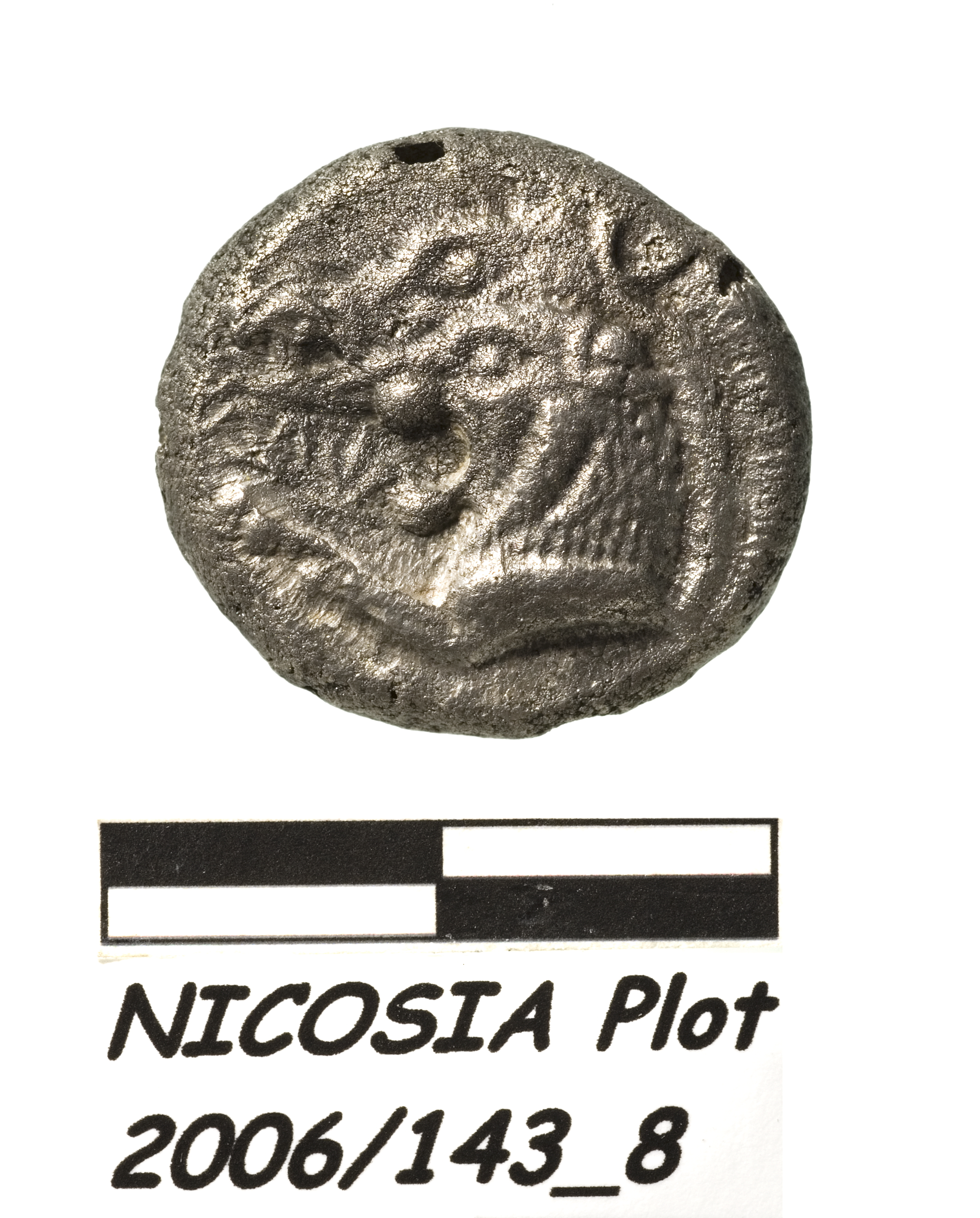
Silver coin from a hoard of 36 rare silver coins found at the east extension of the site (Hadjopoulou and Nikokreontos streets).

Opposite side of a silver coin from a hoard of 36 rare silver coins found at the east extension of the site (Hadjopoulou and Nikokreontos streets).